July 9, 2012: Today was a SUPER busy day....so this will be a really long post!
Rainforest Hike:
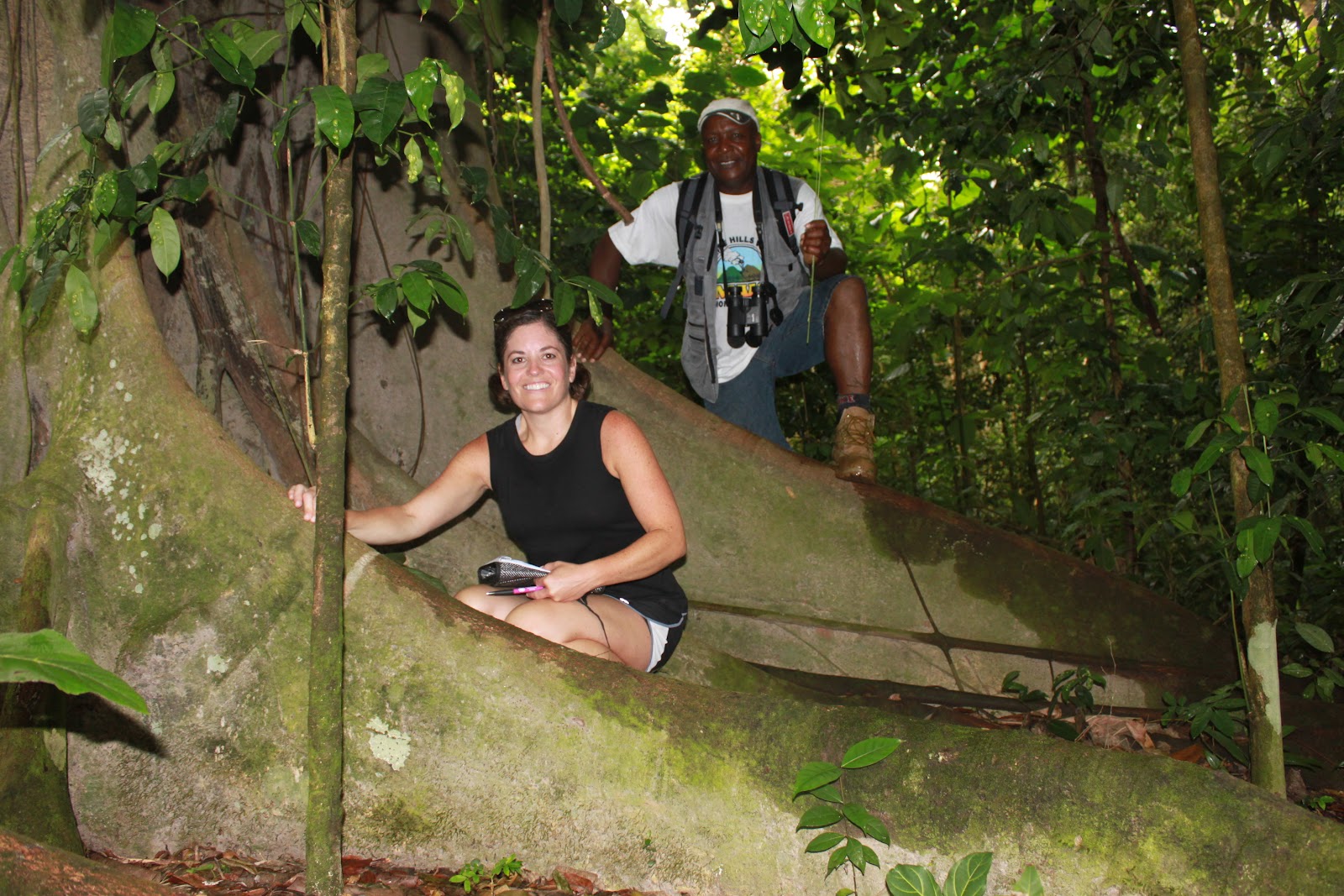
We got to go for a 2 1/2 hour hike through the rainforest. We went on the Oriole Walking Trail. The oriole is the National bird of Montserrat. Scriber, our hike guide was absolutely amazing! He was incredibly knowledgeable and was (in my opinion) the "Oriole Whisperer". He could do bird calls and lure the birds into the area so we could have a better look. I got a couple of pictures of them, but they were still a bit far to get a great shot. The rainforest was breathtaking! I have never seen such a diverse and densely populated forest! Besides the oriole, the only other wildlife that we saw was the Black Widow moth, wasps, and termites. The Black Widow Moth has a great little legend. If one lands on you, you will become wealthy. Unfortunately, none of them landed on either of us! :( Some of the wildlife that we didn't see includes: the forest thrush, the shy bridled quail dove, the mangrove cuckoo, the trembler, bats, and purple throated carib. Other regional endemic species that may be found are the mountain chicken (which is actually a type of frog...not a chicken), the galliwasp (which is half-snake, half-lizard), the tarantula, and the agouti (which is a rodent). We did not see the agouti in the rainforest, but one darted across the road while we were on our way to the hike. They look like a large rat with no tale. I think I'm glad we didn't see any in the rainforest. There were tarantula holes in the ground all over the place. Scriber tried to coax a few out of their holes, but none cooperated! I was disappointed! As for plant life, there was a great diversity! I have three pages of notes on all of the types of plants/trees. One that we saw shortly after we started is called the silver fern (or the local tattoo). It is given this name because it has pollen on the underside of the fern. You can lay the leaf on your skin and the slap it. It leaves a pollen tattoo of the leaf on your skin. I videoed Scriber as he explained it and demonstrated. It was so cool! Be sure to check out the video. Philodendron (elephant ear) was everywhere in the forest. They are called the "lover of trees" because they attach to the trees to reach the light gaps in the forest. They have a mutualistic relationship. The elephant ear grows on the tree to receive sunlight and in return it is able to funnel more water down to the root system of the trees in which it makes it's home. The roots of the elephant ear are used for crafts (mostly for making hats). We also saw many crab eye beans. They are a type of bean that you eat, but the locals often use them for crafts (eyes for dolls, beads for necklace, etc.). Some (there are many others that I'm not listing) other plants that we saw were the vanilla plant, the coffee bean plant, lots of moss, fungi (which was poisonous), the rubber tree (I took a really good video on Scriber describing the rubber tree), bread fruit trees (they make great chips...taste very similar to potato chips), the stinging nettle (the leaves can actually sting you and will leave raised marks that itch, much like a mosquito bite), the cocoa trees and cocoa pods, and the banyan tree (which was my absolute favorite). The first banyan tree that we saw, I thought was amazing. It was huge and the roots were too. Scriber was amused by my excitement of the size of the tree and said, "Wait until you see the other one on this trail". He was right!! The second banyan tree that we saw was out of this world! Scriber said it was probably about 300-400 yrs old. It was the most amazing tree that I've ever seen. The roots towered well over our heads and out of our reach. The pictures that I took will not do the tree justice. There were bats living in a hollowed out section of the tree (you could see the mango colored bat droppings on the roots and ground nearby). The banyan tree was by far the highlight of the hike for me. We also passed by one of the water collection areas in the forest. The water is collected and then distributed to the people of Montserrat. Montserrat is composed of about 90% water. Only about 10% is even being used for domestic use. It has some of the purest water in the world. There is an area on the side of one of the streets called the Runaway Ghaut. There is a legend that goes like this, "If you drink from this burn, to Montserrat you will return" Jon and I both drank from the ghaut and both plan on returning!
 |
| silver fern (local tattoo...see video below) |
 |
| philodendron (elephant ear) |
 |
| crab eye beans |
 |
| vanilla (the green plant on the tree) |
 |
| coffee plant |
 |
| moss (covered the entire visible surface of the rock) |
 |
| fungi (very poisonous) |
 |
| stinging nettle (leaves sting you, leaving raised marks on your skin) |
 |
| empty cocoa pod |
 |
| banyan tree (this is the first one) |
 |
| banyan tree (second one....it was massive) |
 |
| banyan tree (Scriber and I are standing in the middle of the roots...they are huge)! |
 |
| banyan tree - See how tall it is? Scriber is reaching his arm up and he still is not reaching the top of the roots! |
Video of Scriber demonstrating the "local tattoo" (silver fern).
Video of Scriber showing us the rubber tree.
Tour into part of the exclusion zone:
THE GATES WERE OPEN!!!! After lunch, Winston, our taxi tour guide from July 5th, picked us up and took us into the exclusion zone. There are parts of the exclusion zone that you can go into when the gates are open, but some areas are strictly prohibited (the capital of Plymouth being one of them). We got to go into Richmond Hill. Richmond Hill was the sight of the Sugar Mill Museum and the Montserrat Springs Hotel. There was a large area that showed the terrible erosion that has occurred, and houses that were damaged badly, but not destroyed. The Montserrat Springs Hotel was recently updated prior to the 1997 eruption. We actually were able to go INTO the ruins of the hotel. It was an incredible and emotional experience. To see the ruins first hand and walk through the different areas of the hotel was mind blowing and completely unfathomable! We walked in and the front desk was partially buried, with a telephone and credit card machine on top. We walked through the the front lobby, the back office areas, saw the gift shop area, dinning hall, kitchen, and outside to the pool and pool deck. The pool was nearly buried up to the edge with pyroclastic flow. You can see the ladders that go into the flow. At one time there was some water still in it. Winston said that when they evacuated, they could not bring all the cows, goats, etc., so many of the cattle would stay inside the dinning hall with the pool deck and water in the pool right outside. When the water in the pool dried up, the cattle moved on to a different location. Many desks and chairs were partially buried in the pyroclastic flow and everything had a layer of ash or "dried mud" looking pyroclastic material. All of the metal had been rusted terribly due to the pyroclastic flow. Some areas of the roof of the hotel was composed of asphalt shingles and others had tile shingles. The areas were with the asphalt shingles were badly damaged. However, the areas with the tile shingles were completely intact with little to no damage (that should be great advertising for the tile shingle company)!
 |
| A house that wasn't destroyed, but badly damaged. |
 |
| erosion |
 |
| eroded road |
 |
| sugar mill - was transformed into a museum - now it is vacant in the exclusion zone |
 |
| Montserrat Springs Hotel - entrance |
 |
| The parts of the roof still in tact are the tile shingles. The parts that are destroyed were asphalt shingles. |
 |
| front desk - phone and credit card machine on top. The desk is partially buried. |
 |
| This was the entrance to the gift shop. |
 |
| kitchen area |
 |
| dinning hall |
 |
| buried pool |
 |
| pool ladder |
 |
| back room - behind the front desk |
 |
| partially buried desk and chair |
Today was an absolutely unbelievable day for me!!! One of my favorites for sure. Just going into the hotel alone was an amazing treat!